Thursday, April 23, 2015

Against the conventional wisdom on pastured pigs

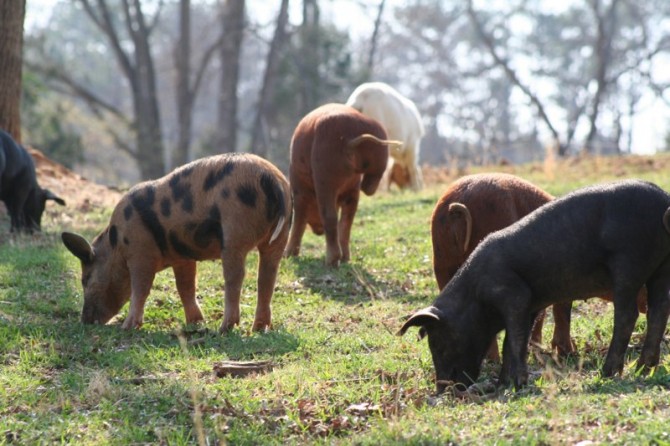
Pastured pigs at a farm in
Massachusetts
(Image: robbwolf.com)
As any farmer can tell you, consumers are becoming ever more aware of the supply chain that provides them their meat, and are becoming more demanding in what practices they expect in that supply chain. Largely the market has shifted against battery farming of livestock towards "free range" systems where livestock are given room to move about freely.

This shift in the market is leading to some interesting conceptions of "pastures". We have farmers talking about pastured chickens and pastured pigs, despite neither being capable of actually digesting roughages in pasture the way ruminants such as sheep, goats and cattle will. While chicken is to a degree capable of using pasture, as it will peck at forage grains and soil insects as well as tender sprouts, pigs aren't capable of getting any significant portion of their diet from a conventional pasture.

When left in pasture, a pig's primary behaviour will be to "root" at the soil, unearthing it with their nose, both to create areas to wallow and thermoregulate, and to search for any tasty big bugs and roots that the pig can find. This is the natural behaviour of all pigs, indeed both domestic pigs and boars have a specially evolved bone in their snout for rooting at soil. Farmers have even adapted this behaviour to their advantage in Europe, where trained hogs are used to root for truffles among tree roots.

But this behaviour is disastrous for farmers hoping to stock pigs in their cattle pasture, as the pigs will gradually tear apart the entire pasture and destroy productive forages without eating them. Hogs will rarely get any significant portion of their diet from a conventional pasture; their rooting will provide them with a degree of the minerals required in their diet and the hogs will occasionally eat any larger roots they encounter as well as young sprouts of certain highly palatable annuals like oats.

Just take a look at this simple guide to pig ration building for small producers in New South Wales:

While it is true that pigs love rooting in and eating pasture, they cannot survive on pasture alone. They need a balanced ration usually based on cereal grain. Pigs are monogastric (single stomach) animals and are inefficient digesters of fibre (only 50% efficiency).

Diets based on pasture are high in fibre... The more fibre in the diet the lower the digestibility.

Pasture should be 10% or less of their daily intake for best results.

Pigs on a pasture based diet have a reduced dressing % due to the increased gut volume for fibre digestion.

Pigs, as monogastrics, have a digestive system very similar to humans. Since we cannot adequately digest roughages, neither can pigs. As farmers it's time to stop stocking our pigs on pastures not designed for them, and keep the roughages for the cow. There are alternatives to pasture building for pigs, that fly in the face of conventional wisdom, that provide far more digestible pasture and better dressing out of your livestock.

A tuber crop pasture will provide your pigs much more useable pasture than simple forages. "Strip-grazing" (leaving your pigs in highly stocked pastures for a single day to forage) of some tuber crops was a once popular here in North America, and today we can improve such systems in either annual or perennial systems.

Annual pastures

If your farm uses pasture as a part of its crop rotation, a perennial pasture will not be your best bet as many perennial tubers are very difficult to eradicate once established and will not be deterred by simply being ploughed under. There are, however, many annual tubers with both agronomic benefits and high digestibility for your pigs.

Daikon (brassica family): this large taproot, related to radishes, is great for its decompacting effect on your soil and its tuber's high digestibility. This crop is a good choice for those of us with more clay-filled soils that don't take well to other tubers, as daikon is very competitive and will drill into less tuber-friendly soil. The young leaves are also fairly digestible for pigs. And whatever tubers are left over, feel free to harvest and eat yourself, this vegetable is a staple throughout East Asia.

Mangelwurzel or Fodder Beet (aster family):
related to the red beets we eat, these larger, golden white beets are used primary for livestock feed in Europe. Though it is easily the best yielding of all the crops on this list, it is sensitive to compacted soil and grows best on sandier soils. The tops are not highly digestible to pigs, who will simply tear into the roots, however you may choose to strip-graze your cattle, sheep or goats on the tops at maturity as they are highly digestible to those livestock.

Peanuts (legume family): while not a true tuber, this unique plant we all know flowers aboveground before curling its stems and drilling its fruit below ground to form in safety. As a legume, this crop has the advantage of fixing nitrogen for other crops in your pasture or rotation. However it should not be overstocked as peanut shells are highly fibrous and this will impact the dressing out of your pigs.

Carrots and Parsnips (umbellifer family): these sweet vegetables, while they don't have the yield of the other options on this list, respond very well to muck soils and are an option to consider for those farming black soil. Care must be taken not to overstock these crops, as umbellifer family crops are full of chemicals known as furanocoumarins that can cause rashes and burns when overconsumed raw.

Note that for annual pastures it is not recommended that you sow potatoes. Potatoes, once unearthed by the pig and exposed to sunlight but still in the soil, will begin producing a poisonous chemical known as solanine and turning gradually green. This can cause serious health issues for your pigs and it's recommended that you plant and harvest potatoes yourself for feeding to pigs rather than allowing them to pasture-feed on potatoes.

Perennial pastures

If you intend to dedicate a portion of your land to being permanent pig pasture, it is much more economical to sow perennial tubers rather than the annuals we're more familiar with. All of these perennial tubers are somewhat uncommon crops you won't find in a supermarket, however they are hardy, high-yielding, and perfectly digestible.

Sunchokes or Jerusalem Artichokes (aster family): this little known vegetable is indigenous to eastern North America. A very rustic perennial tuber crop, sunchokes are nearly impossible to eradicate once established, even for your pigs. Sunchokes have a history in North America of being used as strip-grazed pasture for pigs. For pastures of a more permanent nature sunchokes are a primary choice.
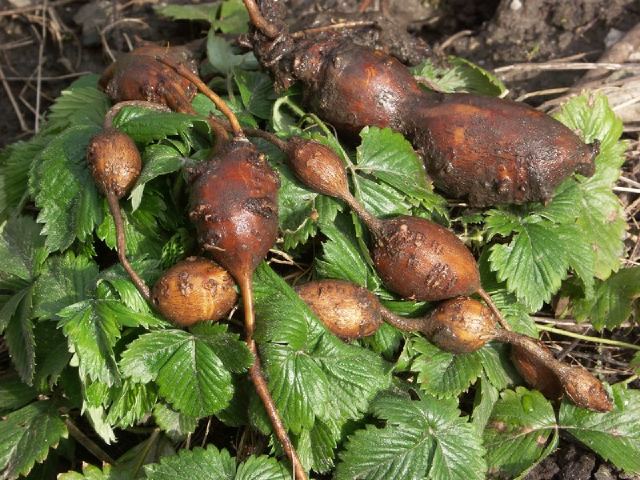
Groundnut tubers
(Image: onlyfoods.net)

Groundnut or Potato Bean (legume family): this vine, also indigenous to eastern North America, produces both edible beans and large strings of edible tubers. As a legume, this crop has the advantage of fixing nitrogen for other crops in your pasture. This crop is somewhat drought-sensitive, so ensure you are planting it in soil where it receives adequate moisture year-round.

Hog peanut (legume family): another vine legume indigenous to eastern North America, like peanuts this crop forms its fruits underground. Both its seed pods and roots are edible, though it does not form large tubers like groundnut. Hog peanut is an option to consider in drier soils where the more sensitive groundnut may not thrive.

Oca or wood sorrel (wood sorrel family): this tuber indigenous throughout the Americas is regularly cultivated in the Andes as a vegetable crop. While high-yielding, oca is frost and moisture sensitive, and is not a good choice for those of us located further north.

Skirret (umbellifer family): a relative of carrots and parsnips indigenous to the UK, this vegetable forms rare fibrous taproots and repopulates itself year after year. Like other umbellifers, skirret are full of chemicals known as furanocoumarins that can cause rashes and burns when overconsumed raw, and so should not be overstocked.

Sunday, September 28, 2014

Farm biofuels: a green solution to the peaker and off-grid problems

The centrale de Bécancour gas-fired generation
plant remains operable despite the wave of fossil-
fuel plant closures in Québec (Image: Le Devoir)
When it comes to electricity generation, Québec is a model to be followed. Hydro-Québec's massive high-north projets have ensured that 97.2% of Québec's total energy production is sustainable hydroelectricity, while simultaneously having the lowest electricity prices in North America. Coal and oil power plants have been completely abolished across the province.

And yet, Hydro-Québec hasn't been able to crawl that final few percentile to total sustainability. For better or worse it is unable to rid itself of its few remaining gas and diesel power plants, which together provide 541MW of generation capacity in the province - which, though it comprises less than 2% of total electricity generation, is essential to the provincial electrical grid.

There are two functions these remaining plants serve. The first is to produce electricity in remote locations off the main electricity grid. Hydro-Québec runs 24 such plants, mostly located in remote far northern communities but also including the centrale des Îles-de-la-Madeleine diesel generation plant which supplies the entire electricity needs of the Magdelan Islands, a chain in the Gulf of St Lawrence famous for its pied-de-vent cheese and extensive white sand beaches.

The second is as what is known as a "peaker plant". Hydroelectricity is not a form of power generation which can be turned on and off rapidly, and when rapid changes in electricity demand occur causing "peaks" the grid requires large amounts generated within a very short time frame. The only reliable method we have of doing this is thermal power generation from fossil fuels. Québec's current peaker station is the centrale de Bécancour near Trois-rivières, a 4-unit gas turbine plant using natural gas. As described by Hydro-Québec itself,

"Given the relatively high cost of fuel needed to run these facilities, they are used only during periods of peak demand. These generating stations have the advantage of taking only minutes to start and stop operations, compared to the longer time frames required by other thermal power stations."

And right now, while Québec continues to burn fossil fuels fracked from shale and rinsed from tarsand in other provinces, there exists a renewable, carbon-neutral source of electricity the province could utilize without any capital investment that can be produced in Québec nearly immediately and in doing so help revitalize the rural economy: the biofuels - biogas and biodiesel.

Anaerobic digesters like this one in Stirling, ON
can utilize waste manure as well as wet biomass
like corn silage to produce biogas suitable for
electricity generation (Image: Biogas Association)
Here in Ontario the idea of producing agricultural biogas to fuel gas turbine power generation is nothing new. Currently 35 farms across the province have installed anaerobic digester / gas turbine systems which derive biogas from manure, vegetable crop stalks and excess silage. The system is surprisingly efficient: a single tonne of cattle manure can produce 48KWh of electricity, while a single tonne of corn chaff produces 335KWh.

In the case of manure, with a single head of cattle producing 21.9 tonnes of manure a year, the entire Bécancour plant could be fueled by capturing the gaseous output of only 391 cattle - or, put otherwise, the output of only 7 average québécois dairy farms. The equivalent in corn silage, with average wet biomass yields coming out to about 20 tonnes to the acre, would require only 62 acres.

Biofuels can also help to deal with the Magdelan Islands' diesel dependency. The madelinots have had to contend with oil spills recently from the shipment of diesel to the plant, when instead it could be using some of the $1.1 million worth of cereal crops produced in the region annually to produce their own diesel, creating jobs in this region with some of the highest unemployment levels in Québec.

Creating value-added production such as biogas is not only ecologically sound it is economically stimulating. The simple reality is that when processing of agricultural products is moved to the farm, jobs are created, and agricultural communities flourish. For Québec - and furthermore, the world - to make the final leap away from fossil fuels, it will take biofuels to be possible.

Monday, September 8, 2014

Mythbusting the critique of the dairy quota system

It's hard to get straight facts about the much maligned quota system which governs Ontario dairying. Despite the fact that every single major farmer organization supports the system - from the National Farmers Union to the Ontario Federation of Agriculture to the Christian Farmers Federation of Ontario - the major media outlets tell us time and time again just how awful it is. From staunchly conservative papers like the National Post and Maclean's to liberal papers like the Toronto Star, even in academia such as this paper from the University of Calgary's School of Public Policy, the average Canadian hears nothing but opposition to supply management.

It seems that everyone is against supply management except for farmers themselves, for whom it has done exactly what it was intended to do - keep milk prices consistent and fair. So where's the truth to it all? What is supply management really doing for Canada? We're going to break down some common misconceptions about the quota system, and what its real impact is on Canadians.


Myth: The quota system, with the total cost for a single head of milking cattle being above $20,000 in most provinces, makes it impossible for new farmers to break into the industry

"if you’re a new farmer, [supply management] is a major barrier to entry: as much as 75 per cent of start-up costs." - Maclean's Magazine 15/08/11

Fact: The reality is that the quota system has several options set up to provide a start-up quota to new farmers. As an example, Dairy Farmers of Ontario, the body responsible for transfer of quotas, offers the New Entrant Quota Assistant Program, which will loan new farmers 12kg of quota for up to 16 years without cost - which, in Ontario, is currently a $300,000 value.

Also, quotas are not the majority of start up costs for most new farmers. With average farm land prices at $4000/acre, a single pedigreed Holstein heifer at $2600 - $3400, and state of the art milking technology running a $210,000 price tag, dairying is a tough game to break into, which is why New Entrant program exists to lessen the burden.


Myth: Supply management is effectively a subsidy from the Canadian consumer to farmers, since dairy prices are much higher in Canada than in countries without supply management.

"Canadians pay up to three times as much for milk than their neighbours to the south... dairy production quotas alone cost the economy $28-billion per year. That’s thousands of dollars per household." - National Post 20/09/13

Fact: unlike most major dairy producing countries, Canada does not directly subsidize farmers a single nickel. The United States, a country without supply management, provides over $4 billion in direct subsidies annually to the dairy industry. In no sense of the word is supply management a "subsidy", it is in fact supply management which allows dairy farmers to continue farming without any subsidies whatsoever. And, the quota system itself does not cost the economy a single penny since quota exchanges are entirely farmer-run, farmer-operated, and farmer-funded, and are not government institutions.

As to the allegation that Canadian dairy costs 300% that it does in the USA, the current average retail difference between US and Canadian milk is $0.44/L or a 29% increase, the current retail different between US and Canadian cheddar is $0.93/kg or a mere 6% increase. This is actually lower than the general difference between the two countries in food prices, which are 57% higher on average in Canada than in the US.


Myth: Eliminating supply management would reduce the price of dairy products for consumers.

"There is no question that phasing out supply management brings benefits to almost all members of society, excluding the producers, through lower prices and especially to low-income people." - Professor Ian Lee, Carleton University Sprott School of Business

Fact: When Australia eliminated supply management of dairy in June 2000, the price of milk rose three times as fast in the proceeding 3 years as it had in the preceding three years - having increased only $0.9/L from 1997-2000, but having increased $0.27/L from 2000-2003. Over the same time period, milk prices in both Canada and New Zealand (Australia's neighbour which has retained its supply management system) remained near-constant. The only side effect that Australia's experiment in eliminating supply management has produced is making farm gate prices for milk more volatile.

Wednesday, August 13, 2014

Solving the seasonal agricultural worker crisis

Despite the federal government's new reforms in the use of temporary foreign workers following revelations in the media of abuse and misuse of the program, the agricultural stream of the temporary foreign worker program has remained practically untouched. In fact the program has been flourishing, having gone from 13,590 approved positions in 2005 to 39,700 in 2012 - with nearly 3/4 of total approved positions being through the Seasonal Agricultural Worker Program (SAWP).

Many Canadians are starting to feel cheated by the temporary foreign worker program with the number of temporary immigrants admitted now being higher than the number of permanent immigrants. They feel cheated out of jobs that, in a weakened Canadian economy, could potentially be going to Canadians or be used to bring permanent new arrivals.

But to this, Canadian farmers can only shrug. After all the federal government seems to agree with them, there is enough a demonstrated lack of available seasonal agricultural workers to merit the protection of the SWAP. Just listen to Mr. Edwin Klassen, manager of a potato farm in Manitoba, as he tells of the human resource difficulties being faced by farms,

“If I got three skilled applicants today I’d hire them on the spot... Right now the labour market is very tight. I’m getting very few quality applicants for hire,” says Klassen. “I’ve been in this position for five years and in the past I would very often have had a list of anywhere from 10 to 20 applicants who would want to be grading potatoes, and since last summer that list is down to two or three.”


“I know that other potato growers and cereal farms are drawing labour from Winkler, Morden and other areas as well,” says Klassen. “Quite a few grain farms are operating 10,000 to 20,000 acres, so they have a workforce of a dozen or more. They’re all looking for the same skills — guys who can operate equipment or repair a piece of equipment.”

The catch of course is that the positions this company is having great difficulty filling are seasonal jobs, guaranteeing employment for a few months at best, and they are requesting workers with a fairly wide breadth of specific skills already under their belt.

It may be a hard pill for farmers to swallow, but seasonal jobs are not a liveable income for workers. The reason you can't find help is that no skilled, experienced worker is going to take a job with zero job security that will only provide for them and their family for a few months. A worker with marketable skills will only take work that, at the very least, provides a liveable income and a significant degree of job security.

So what are the alternatives? Let's break down a few.

1) Student summer jobs


With most seasonal positions needing to be filled over the summer season, an obvious choice is the one segment of the population who are available for hire during the summer only - students. And there's certainly no shortage of summer student labour. This summer alone 460,581 Canadian post-secondary students were looking for but unable to find a summer job, with the post-secondary student unemployment rate sitting at 16.5% percent this summer. Over twice the rate of the general population.

Around the end of the school year farmers should be trying to advertise a summer job in places where students can see it. Colleges and universities typically have summer placement centres of some sort that will be glad to take your job posting. It's also possible to hire students who enrolled in college programs with cooperative education components, especially in the many horticultural programs in Ontario colleges.

2) Apprenticeships and cooperative education

Most farmers are seeking out workers who already have the fairly wide breadth of skills required in agriculture under their belts instead of training workers themselves. This is a missed opportunity since training itself is a form of payment which costs little to the farmer but is invaluable to many, especially so young workers trying to get a start on their career.

A common route that many youth are happy to go is apprenticeships - with more provinces rolling out agricultural apprenticeship programs such as the dairy, swine and fruit farm apprenticeships in Ontario, the farm technician program in PEI or the "green certificate" programs in Alberta. Taking on apprentices is also rewarded with tax breaks and wage subsidies that offset the cost of taking on full-time workers.

3) Coopératives d’utilisation de main-d’œuvre

A popular system in Québec translating to "cooperative for the use of labour", it involves several local farms coming together to form an association which employs full-time, salaried workers collectively. The workers are shared between the farms, which are quite often involved in completely different facets of production than one another, allowing the workers to be engaged throughout the year working with many different crops.

The primary advantage to the farmer is that they have the benefit of multiple skilled workers available throughout the year at a fraction of a cost of engaging full-time workers; the primary advantage to the worker is that the employment is full-time rather than seasonal with high job security. This solution requires quite a bit of cooperation with your fellow farmers, but if you're on good terms with your neighbours this can save you a mint in labour costs.

*****

Agriculture is the basis of the rural economy. When agricultural producers are unable to provide an employment model which is viable for workers and are forced to rely on temporary foreign labour - who contribute nothing to the economy, and instead export their wages back to their home country - there is a crisis at hand.

Farmers have a responsibility to ensure the vitality of rural communities. Rather than depending upon a broken program extended by a government which is more than happy to introduce anything which dilutes the local labour market and thus the conditions of working class Canadians, farmers should be finding innovative and cooperative solutions to create viable employment opportunities, especially for the youth, who are the future of our rural communities.

Saturday, August 2, 2014

Where were eastern Ontario's public colleges when Kemptville needed them?

Province-appointed facilitator Lyle Vanclief addresses the public
at the July 16th town hall meeting in Kemptville. He refused to take
any questions.  (Image: Nick Gardiner, The Recorder and Times)

As many of you already know, on March 12th the University of Guelph announced that it will be closing its two Ontario Agricultural College campuses in Kemptville and Alfred, leaving the only remaining agricultural diploma in the province at Ridgetown in Kent county - a campus located over 600km away from most eastern Ontarians and teaching for entirely different agricultural conditions.

In their March 12th statement the university attempted to justify its austerity actions,

"Despite efforts over the past several years to introduce new revenue-generating educational programs and attract new students, enrolment at both campuses remains stagnant while operating costs have increased. Costs per full-time equivalent student are substantially higher at these campuses..."

The wording of the announcement is very telling. The decision was not educationally motivated but financially - what they call "stagnant" enrolment rates have been consistent without decrease ever since U of G took over Kemptville operations in 1997.

Kemptville is being discarded as a bad investment by the university, regardless of its essential nature to the economy of eastern Ontario, it failed to be "revenue-generating". I for one was under the impression that colleges were a public service, not a source of revenue for university administrators to furnish their sunshine list salaries.

I myself was hoping to attend Kemptville this September and was shocked by the news. Kemptville has been an institution among eastern Ontario farmers for nearly 100 years. Any and every kid hoping to take over the family farm went to Kemptville if they could. For generations it has been the basis of farm education in our communities, and without it a whole generation of rural youth will be without access to the latest agricultural knowledge.

Fortunately for me there was an alternative. Immediately after the closure announcement for Campus d'Alfred talks were underway with Collège boréal and La Cité collégiale, Ontario's two French-language colleges, to keep the doors of the tiny francophone campus open. In the end a funding partnership with Collège boréal, through which Alfred already had a partnership for its veterinary program, managed to save the campus. By March 29th the institution was once again accepting applications, just over two weeks after the official announcement of closure.

Other prospective Kemptville students are not so lucky to be bilingual as I am. For them, the choice faced right now is between a jump to the other side of the province and abandoning the family farm, or no education at all.

So, while Ontario's French language colleges immediately came to the aid of Campus d'Alfred, where were the English language colleges of eastern Ontario?

Afterall the Kemptville College Renewal Task Force, a committee formed by the Kemptville College Foundation, announced on April 8th that they were in talks with St Lawrence and Algonquin colleges. Yet by a month to the day later when the task force launched a formal request for expressions of interest, it seems the colleges had lost interest.

When I was in Kemptville on July 16th for a town hall meeting (that's me with the ponytail in the video!), we were informed that the task force had received only two formal expressions of interest by the May 28th deadline - one from a private sector group and one from a public sector group, both of which were said to be "international" (as in, not Canadian institutions) but remained unnamed.

Furthermore we were told that at this point Kemptville would not be resuming operations in time for September, and that even a potential September 2015 start date was unlikely at this time. The solution that was ultimately reached for the interim was having the municipality of North Grenville operate the college itself, a task it was willing to take up so long as it could be assured that municipal taxpayers wouldn't be footing the bill. Since this solution requires both negotiations with Guelph over their "intellectual property" (the agriculture diploma program) and negotiations with the province over funding, the task force informed us they were expecting a three-year period before the college would be up and running once more.

So what happened to the interested colleges? It couldn't be that they got cold feet about having satellite campuses since St Lawrence College already has three campuses, as does Algonquin. At any rate we weren't getting any answers from the task force as to why the colleges had dumped them - when asked outright, the task force dodged the question. Presumably because any negotiations which took place were strictly confidential. 

From Algonquin we can get a bit of information from the minutes of the Algonquin President's Council for their March 12th and April 2nd meetings,

"PC members discussed the potential impact and opportunities of the closure on Algonquin College and agreed it will conduct a high level financial and academic program review of the Kemptville College entity and report back to PC by the end of June on what opportunities may be available..."

The minutes give a report back date of April 2nd. Sure enough in the April 2nd meetings, we see this,

"C. Brulé updated PC members on the review of the University of Guelph's Kemptville campus. Discussion included steps taken to date, anticipated next steps and the expected frequency of the exchange of updated information. Discussion followed regarding apprenticeship and communication strategy."

And then, nothing. The minutes list no follow-up date, and Kemptville isn't mentioned in any subsequent PC meetings. From St Lawrence we get even less information, the minutes of the May 6th meeting of the Board of Governors gives a brief mention by Vice President Academic Lorraine Carter,

"The Sr. Vice-President provided a quick verbal update on Kemptville, pointing out that the team is still looking at ways that St. Lawrence College could support this demographic"

I've sent an email to both Claude Brulé and Lorraine Carter, who are mentioned in the minutes, to ask whether Algonquin or St Lawrence respectively plans to be involved in the Kemptville renewal process but as of yet I've received no response. I haven't got high hopes that I'll receive anything but the same vague answers provided at the town hall meeting.

One thing's for certain, both St Lawrence and Algonquin definitely chose to abandon Kemptville and consequently abandon all of eastern Ontario's agricultural communities. Perhaps they made the same revenue-based analysis that U of G had made. Both of these colleges have much larger budgets than Collège boréal and yet were seemingly unwilling to come to the aid of this vital educational institution in their locale the way boréal did so swiftly. And without these colleges' aid on the horizon, the future of agricultural education in the province looks bleak indeed.